
Increasing Adoption of Air-To-Water Heat Pumps as an Alternative to Traditional Central Cooling and Heating Systems
For many years, commercial buildings of substantial size have utilized water chillers and gas-fired boilers as a means of providing cooling, heating, and dehumidification for their interior spaces. These water-side systems, combined with various air-side systems, can deliver a reliable and energy-efficient HVAC design. More recently, the HVAC industry has shifted toward reducing its reliance on fossil fuels for heating buildings, leading to advancements in electrified heating technologies, including heat pumps.
This article focuses on air-to-water heat pumps as an energy-efficient, environmentally friendly design alternative. An air-to-water heat pump uses outdoor air as a heat sink in cooling mode and as a heat source in heating mode to either remove heat from or add heat to a building’s water loops. Therefore, a series of air-to-water heat pumps can replace traditional water chillers and boilers as the sources of chilled and heating hot water in an HVAC system.
Advantages of Air-to-Water Heat Pumps:
Energy efficiency
- Increased energy efficiency which results in reduced energy consumption, operational carbon, and operational costs in most applications.
Air-to-water heat pumps do not use natural gas
- Reduction in the usage of fossil fuels on-site can help with a project’s sustainability goals and avoid the need for future retrofit of the heating system if natural gas usage continues to decline.
Design flexibility
- Air-to-water heat pumps can be coupled with a variety of airside systems, giving building owners and system designers options for different applications.
- Air-to-water heat pumps can be retrofitted as a replacement for existing central chillers and boilers, with few piping and control modifications required.
Incentives for installing heat pump systems
- Incentives can reduce the initial cost impact that could be seen when installing air-to-water heat pumps.
- Air-to-water heat pumps would be eligible for incentives being offered by the federal government.
- Additional state and local incentives may also be available and could be stackable with federal incentives.
Simultaneous cooling and heating
- Certain air-to-water heat pumps are designed to offer cooling only, heating only, or simultaneous cooling and heating through heat recovery. This is a highly efficient option for buildings with large dehumidification loads or that require significant amounts of re-heat to control space conditions.
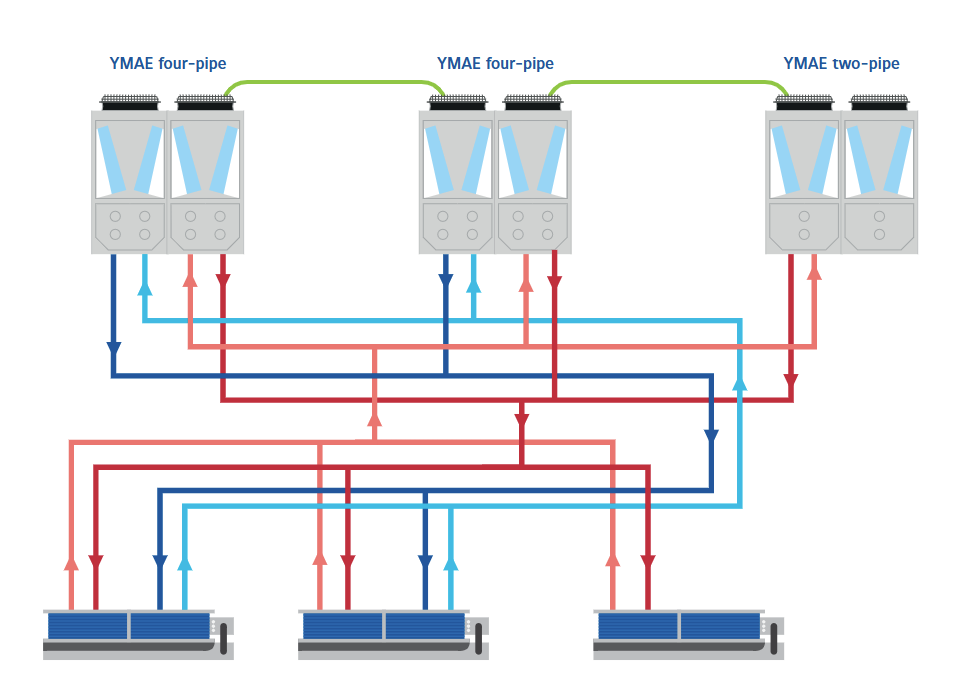
Credit: York YMAE Air-to-Water Inverter Scroll Heat Pumps by Johnson Controls
Potential Drawbacks of Air-to-Water Heat Pumps:
Higher equipment cost
- Purchase and installation of air-to-water heat pumps can be a higher initial investment when compared to traditional chillers and boilers.
- It is worth noting that the incentives currently available for installing heat pumps can help offset some of the increase in equipment cost.
Reduced performance in extreme climates
- Heat pumps perform best in climates that do not experience extreme outdoor temperatures. Buildings utilizing heat pumps in northern portions of North America and Canada should consider a source of supplemental heating to ensure that heating demand is met during extreme winter conditions.
Hot water temperature limitations
- Current air-to-water heat pump technology supplies a maximum water temperature of around 130 – 140 °F when producing hot water heating. In a new construction project, this design temperature can be used to ensure hot water coils throughout the building are properly sized. However, when considering a retrofit in an existing building, the heat pump hot water temperatures and existing equipment coils must be carefully analyzed to ensure the building heating design is not adversely affected.
Size limitations
- Air-to-water heat pump products on the market today commonly have a range that tops out around 300 tons. Buildings with significantly higher cooling and heating loads will require larger quantities of heat pumps to achieve the required capacity.
Designing cooling and heating systems around the use of air-to-water heat pumps can help building owners reduce operational costs and lower their overall impact on the environment. As the adoption of heat pump technology increases, equipment manufacturers will continue to allocate resources to update products that are available on the market. Product developments are expected to improve performance and reduce initial cost, making heat pumps a viable option for many applications located in a variety of climates.